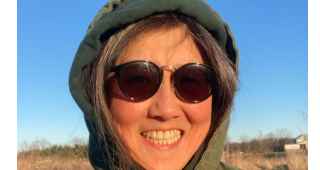
Community Farm Chef, Kori Kanayama authentically and vulnerably shares her journey with Anxiety.
” I’ve tasted this way of being is being more true to myself on one end and on the other, what are we transforming ourselves for? I would like to do something to serve, to support others. I am cooking as a way to hold space and bring people together. There’s a reward enough in the process of transformation while being resilience, and not being so relentless to myself. I am learning a hard lesson about what happens when I neglect myself. In my life journey, the last person to get nourished was me.
Kori Kanayama is a Community Farm Chef enriched by an accomplished background in organisational development. Described as a teacher who cooks elegantly nourishing seasonal foods in harmony with nature using the highest quality ecologically grown produce.”
” As part of healing, I am making the connection. Being kinder to myself is allowing me to serve. If I am not resilient, I cannot serve. I see a direct connection, the drive to succeed, the drive to coexists with self-compassion and holding a space to see how exactly I could be of service. There’s a little bit more room, to be forgiving, to be kinder, to be gentler to others, but most of all, to myself. The gentle, tender and more pragmatic shift in focus intertwined with self compassion, is helping reduce my levels of anxiety. “
Who is Kori Kanayama?
Kori Kanayama is a Community Farm Chef enriched by an accomplished background in organisational development. Described as a teacher who cooks elegantly nourishing seasonal foods in harmony with nature using the highest quality ecologically grown produce, she recounts her journey with anxiety and how food and nature is healing her.
Kori Kanayama | Community Farm Chef can be reached at purslanecommons.com |. She is on LinkedIn | Instagram | Facebook | Takeachef profile
[0:00:00] Paula: Welcome to Future Focus, Wellbeing and Resilience, where we focus on journeys and strategies that keep us well and support our resilience. Tesse Akpeki is the host and I am the co-host. And we recognize that no two journeys are the same. We know that there’s some habits, practices, and lessons that can nurture us and help us flourish and strive, and we love to capture and share these pearls of insight, these stories, and these pearls of wisdom with you.
[0:00:34] Paula: Today we have a very special guest and her name is Kori Kanayama. She is a community farm chef. So, I’ll tell you a bit about her. She’s a community farm chef that’s available for live in chef assignments, for group workshops and intimate catering. She lives on a farm and cooks seasonal foods in harmony with nature, respecting the innate flavors and goodness of ecologically grown local produce, which combines traditional Japanese, Italian, and other cultural food ways. Kori cooks and teaches how to cook authentic dishes that nourish and heal from the inside out. Our topic today is anxiety, and with that, I want to welcome Kori Kanayama to Future Focused Wellbeing and Resilience.
[0:01:31] Kori: Wow. Thank you so much, Paula. It’s such a privilege to be with you and Tesse.
[0:01:36] Tesse: Kori, thank you for saying yes. And when I heard you speak at another meeting on belonging and journeying, I thought we’ve got to have you on this show. And thank you for being vulnerable, thank you for sharing your experience on anxiety. So, I’m going to kind of start off with a question about facts of your personal and filial upbringing. How do you think they might have contributed to you being susceptible to anxiety?
[0:02:09] Kori: Yeah, that’s a great opening question. I mean, part of my journey is learning more about anxiety and being anxious. I did share with you before that I did not realize until it was a kind therapist pointed out to me that I might be anxious. So, the part of the definition of being anxious is like the tendency to focus on the downside of how things might turn out. And then, so having a strong impetus to act, like continually act to ameliorate, like things possibly going wrong. Like it’s much harder to think about things might be all right. You may not need to do anything about it, but then the anxious mind could start thinking like, oh, I have to do something about this. I have to control this. And it took me a while to realize that’s what I’m doing and that that was contributing to my state of mind. And it took me a while to realize that this was making things more difficult to me, like the anxiety, it’s not possible to eliminate anxiety, that is not the goal, but like having some kind of a healthier boundary that like to be aware that there is anxiety and that we can learn to live with it. Anxiety could be, didn’t you say Tesse, that anxiety could be our friend. Something like that. So, I think I am on my journey to do that. Did I answer your question?
[0:03:55] Tesse: Yeah, I think it does. And then the two things that stand out to me right now, the first one when you said you didn’t know that what you’re experiencing was anxiety until someone pointed it out to you. So, that’s a curiosity. The second thing, what I shared with you was that I’m learning because I have anxiety and I struggle with a lot of anxiety beyond the normal. And what I’m doing these days is to embrace anxiety. So, it’s my friend and my ally rather than something that diminishes or overwhelms me. And partly that involves actually when I’m anxious to inquire from my anxiety what it’s trying to tell me. And with that sharing of itself as an emotion, it’s building me and strengthening rather than breaking me down. And that’s what I’m learning about. Not seeing it as a defense in a negative way, but seeing it as a protector in a positive way and a guide towards what I need.
[0:04:57] Kori: That’s such an affirmative and brilliant way of seeing anxiety. I salute you, Tesse. Thank you so much.
[0:05:09] Tesse: Thank you. But I have to be honest with you, I can’t do it by myself. I have my faith, number one and then I have therapists are helping me. But on my own, I think I could have done the kind of the paddling by myself. I’d be too anxious to do that.
[0:05:24] Kori: Likewise, likewise.
[0:05:30] Tesse: Paula, sorry.
[0:05:34] Paula: No, no. Sorry. I’m listening to both of you. I love how Tesse, you said we can embrace her anxiety as our friend. But something that jumped out at me is that the question you asked, how did her filal upbringing possibly contribute to her being susceptible to anxiety? And that is segue into the question that I want to ask her, which is, what events in your adult life have exacerbated this tendency to be anxious?
[0:06:06] Kori: Thank you so much. So, I’m not sure that I’ve actually answered the first question about my childhood events. I think I would like to focus on this like always present demand to be excellent and high achieving. And then, so when that pairs up with anxiety, I think it could put us in a place where, like, I have anxiety if I don’t think I am high achieving and some things happen in my life, like there was a big focus on bringing home good grades and I didn’t always succeed in all of the subjects. I would do great in some and pretty poorly in terms of grade in others. So I think that probably contributed to latent, always present anxiety that I’m not good enough. You know what, that was really the key I think, about how this affected how anxiety came into play a major role in my life. It’s that this feeling always in the background, I’m thinking I’m not good enough. So, that’s my answer to your first question.
[0:07:21] Kori: And then the second question, and so I already had this tendency to be anxious. There’s one particular event in my early adult life, in my early professional life. I graduated from college and I held a job that was an office job. It was a job I could get after college, and it sustained me as a young professional in Los Angeles, in Southern California. But I really wanted to be working in like preventing gentrification in immigrant neighborhoods and neighborhoods where struggling people live to make it possible for them to stay. And the job that I got in the nonprofit sector, my first job was to write grant applications and write reports and execute events for a nonprofit that was renovating old hotel buildings into housing that folks can afford. I was elated to have the interview and be hired. And then after I was told that the job was mine, I asked if the salary could be a little higher. And the executive director, the chief executive of the nonprofit, did not react well. And he said that he basically threatened to pull the offer.
[0:08:54] Kori: I am looking back. That shaped a lot of my behaviors following. So, it helped me silent when I could have spoken up about something. It shaped my early professional career. And I didn’t realize until much later just how traumatic that felt and how much that affected me. And there’s a good ending to this story because he had a quite a tough upbringing himself. And he was a generous, good human being who wanted to have a diverse staff people. And without him, I couldn’t have gotten a foothold in the US. I didn’t have permission to stay in the states at the time after graduating from college, he sponsored me and that is how I could get my green card. And then I got my citizenship after. So, we reconnected later, and somehow I had the connection with him to tell him that I had some difficult times working for him without mentioning that particular incident. And he listened and he said that he knows that he could be difficult at times. And he apologized to me. We hugged and it was beautiful. A couple years after that he passed away. It was an incredibly healing experience. I don’t know how you make sense of that particular episode.
[0:10:43] Paula: That make a lot of sense. See how you know something, go ahead. No, no. Finish what you’re saying and then I’ll tell you what I’m thinking. Go ahead.
[0:10:47] Kori: Resiliency. So, I had enough connection with him to bring something up from the past because I thought that, I think in my heart of hearts, I thought that he would be able to have this conversation with me. And I just waited into the waters and it added a lot to my own wellbeing, so I’m just connecting it to your themes here of your show because you’re so skillful the way you ask questions. So, thank you so much for the opportunity. I don’t think I’ve ever talked about that in quite this way before.
[0:11:31] Tesse: Paula, what you were going to say something?
[0:11:34] Paula: I was going to say how just pictured her a new graduate or relatively new to the working world, and an incident like that could really, really impact you. In ways that it’s long reaching. It takes a long time. And I was also going to say, I’m happy that you were able to subsequently talk about it with him and realize that maybe it wasn’t even intentional. And I started seeing it more from this point of view when I worked with some younger people. And I would see how they would panic sometimes about someone my age, okay, let me use myself and not me, but someone my age and who they had to probably present to. And I knowing that older person from a personal perspective, a personal angle, I’m looking at how these young people were, oh my God, she wants this person going to say, and they say one thing. And it made me sit back and realize that two things, one, that I was now being viewed as an older person, and two that just.
[0:12:45] Paula: And two, it brought me back down memory lane when I looked to people who like my parents’ age. And I was so afraid only to get to that age and realize that those older people were people too. They had similar experiences as we had that shaped their lives into where they’re and many a time we look at them at the position they are in life, whether CEO or whatever, we don’t know their backstory. We don’t even think many times that they had a journey to get this.
[0:13:15] Paula: What am I saying is that as older, more seasoned people, we need to sometimes realize that our words can be far reaching, it can impact a young person’s life for many, many years. And you may not even realize it so much so that I now tell young people, we were young too. So, some of the things that you are afraid of, we understand. We’ve been there. We were afraid of someone too. We were afraid of failing. We were afraid of getting bad grades. We were afraid of not being successful. I was afraid of my parents, I was afraid of my mom in particular and we forget that part of the journey when we look at younger people. So, thank you so much for telling that story, because I know someone listening to that, will say, me too. That was me, my life, my anxiety, my people pleasing all came from yes, we want things somebody said.
[0:14:14] Tesse: All that is amazing. It’s so amazing. As we’re talking about this and we’re thinking about wellbeing, wellness, resilience, first and foremost, Kori, like Paula said, I applaud your courage. I applaud your transparency and your authenticity in going back and in a way reestablishing the connection with somebody who you grew to know in the organization after that. And as you speak, I’m thinking of an English saying, which is, they say sticks and stones may break your bones but words never hurt you. And what I think is words are cheap, and yet words are costly.
[0:15:00] Tesse: So in traumatic fashion, the events that set us back, the things that our body remembers and keeps the score really, really important to hear from words that are said to us, or attitudes that are displayed. So, thank you for actually bringing that up and in such a loving way and such a kind way. And I think with him no longer with us, we have that continued connection that you’re still connected with him, and you did that peace, you did that peace while he was still on earth to hear it. So, I’m acknowledging that you are on a continual path of self-transformation, and you tell us that you continue to grow every day in every way. So what is helping you to embrace the change that you’re embracing, to be the change you want to see in the world? What’s helping you do that?
[0:16:01] Kori: Once I’ve tasted this way of being is being more true to myself on one end and on the other, what are we transforming ourselves for? I would like to do something to serve, to support others. This is not really about me or my achievement. That’s why I am cooking as a way to hold space and bring people together. And so I think there’s a reward enough in the process of transformation while being resilience, like not being so relentless to myself. Like so I did learn a hard lesson about if when you neglect oneself, when like the last person to get nourished was me, I would just give myself away. Not always, but like, in the overall picture, that was my impetus. So, I now make the connection. Being kinder to myself is allowing me to serve. If I am not resilient, I cannot serve. And so these things are probably more compartmentalized before now I see a direct connection, the drive to succeed, the drive to achieve. For me, it now coexists with self-compassion and having like, I guess also like holding a space to see how exactly I could be of service. And so there’s a little bit more room, I think to be forgiving, to be kinder, to be gentler to others, but most of all, to myself, I’m not sure if I’m making any sense.
[0:18:11] Tesse: Perfect sense.
[0:18:12] Kori: Okay. That is how I think of the life journey. I mean, it’s my one precious life. I may be reincarnated into something after I die, but I don’t really know about that right now.
[0:18:27] Tesse: You are so poetic in your expression. You’re one life to be kinder, to be gentler, to be more compassionate. And your words actually resonate with me when I think about what Paula often says, reminds me, you cannot pour from an empty cup, not going to happen. So, and you cannot self-abandon yourself or neglect yourself. You cannot do that. But again, coming back to some of my journey right now, it’s understanding why there’s a tendency to self-abandon, where there’s a tendency to neglect and this healing of those tendencies with self-compassion and with support to meet the trauma where it is and to release it so that it’s no longer living in that way. And it sounds to me that your journey is a journey where you’re releasing that, recovering from that, letting it go. And choosing, choosing deliberately and intentionally to do and be something different, that’s to be applauded, celebrated, and highlighted. So thank you so much, Kori, for your courage. Paula, I hand over to you.
[0:19:48] Paula: Yes. Interestingly, some months ago I met a lady who was a culinary anthropologist. And she talked about how there is a connection between our food, between our health, and even with leadership. And listening to you talk, Kori makes me think about that. The impact of our dietary, we talked about that off camera sometime ago. The impact of our foods, our culture, sitting down for a meal together, like for you, encouraging people to cook is a way of taking care of ourselves.
[0:20:32] Kori: Yes, absolutely. Like, so I went through this phase of not having a lot of resources to, I was in the space where I was not earning money and living on savings. I didn’t feel like I had a lot of money to spend for the necessities. But I realized eventually that because part of my healing journey was eating the amazing produce that my friends are raising. I mean, it is the best use of my money is what I eventually realized.
[0:21:10] Paula: Choose to spend it on nourishing food. So important in this day and age, because I also spoke with someone way back. And we sometimes forget that the soil that our food grows in, the food gets the nutrients from the soil. So if the soil is sick, the nutrients is getting is not — when we eat those foods, we’re eating whatever, well, I don’t even know if it’s just call it nutrients, chemicals or whatever. Whatever that plant absorbed from that soil that wasn’t good, we’re ingesting it. And even if it’s an animal, if we eat an animal that ate the plants that grew on that soil, that wasn’t healthy for us, we ingest that as well. And so we need to be very mindful about what we put into our mouth because it impacts us in every which way. And this may be a lot more yourself, you know what I eat, where was it grown? Because something could be organic. But what defines organic, it still comes down to where is the source or where did that plant, where did that organic thing, what did it feed on? What was grown in grown? Then I can actually feel that, I’m actually taking care of myself or my family or my loved ones. So, yes I know what you talked about.
[0:22:32] Kori: Paula, you made that very valuable connection. I just had the same conversation when I went picking raspberries and Dave, who raised those raspberries, I caught him on video talking about, it’s all about the soil. Yeah, that’s it. It’s actually pretty simple.
[0:22:50] Paula: Oh my gosh, we could talk with you forever.
[0:22:53] Tesse: Yeah, this kind of brilliant. I just wanted just a very quick thing because Kori mentioned a book and which I’ve kind of downloaded it. Thin slices of anxiety, observations and advice to ease a worried mind. You said this book impacted on you. And kind of as we close this, what was the key things that you drew from this lovely book?
[0:23:17] Kori: Oh, so it is a small book of illustrations that really impacted me because it gave me a deeper understanding of what anxiety is and how it is impacting me. Like, for example, that statement I made earlier about focusing only on the what could happen that would be negative, even though things can also very well go well. Like there are pictures of this drawings that are kind of deceptively simple or even crude, but they’re just very evocative and expressive of the experience of being anxious. It made me not feel alone. Here’s a person who made drawings about being anxious. I just really liked it so much. I could find puppies of this book from a used book seller online. So, for a while I bought a bunch of copies and I gave them away because Lord knows there are many of us who are anxious.
[0:24:33] Paula: Wow. So many of us are anxious and that’s why we do this show. That’s why we do future focus, wellbeing, and resilience. But so many who are listening, tuning in, we ask that you share this, share this topic, this episode, I mean with others because anxiety is not anything to be ashamed of. It’s a global thing. And so if you love what you just heard, we’d invite you to write us a Raven Review, not just a regular review, but a Raven Review. And if you’ve got any questions or topics that you’d like us to cover, we ask that you reach out to us on our website, which is www.futurefocus.com. Thank you so much, Kori, for talking about your anxiety journey, and I know what you have shared will impact so many. Thank you.
[0:25:25] Kori: Thank you. Thank you so much, Paula. It was a privilege.
[0:25:30] Tesse: Kori, I embrace you and your courage. Thank you.